Why the Club Noticeboard Still Matters
A well-kept club noticeboard makes dates, changes and small requests easy to spot, so members can find the right information and act without chasing it.
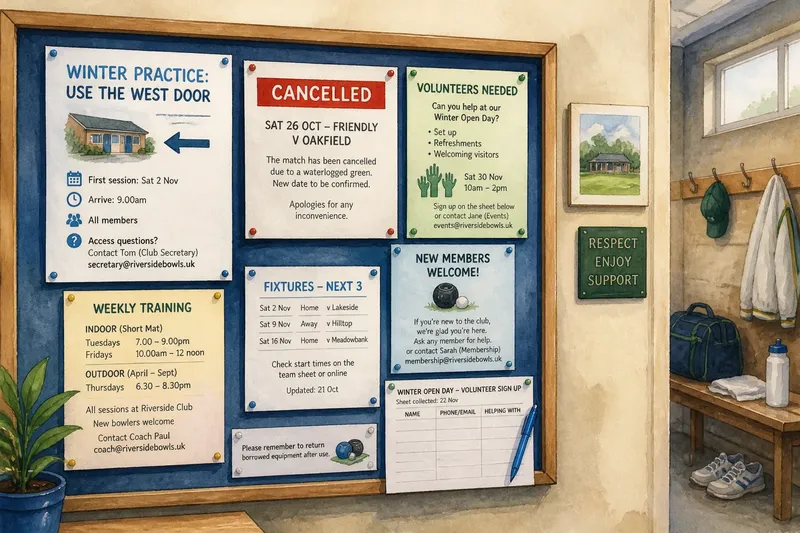
The common mistake with a club noticeboard is treating it as a place to pin everything that arrives. The cost is practical: a member looking for tonight’s room change may miss it beneath old tournament sheets, while a volunteer’s simple request gets no response. A useful club noticeboard is not an archive; it is a shared prompt for what members need to know or do next.
That matters in a sports club because people often pass through at different times. One member sees the board by the changing rooms; another only comes in for a weekend fixture. A clear display gives both a chance to catch relevant information without depending on a message being forwarded or remembered.
What should your noticeboard do?
Start with the board’s job, not its decorations. It should answer a small set of everyday questions: what is happening, when and where, who is it for, and what action is needed? If a notice does not help someone decide or act, it may belong in a club archive or online group instead.
That does not mean every item must be urgent. A welcome note for new players, a call for volunteers, and a fixture change all serve different purposes. The board works best when those purposes are visible at a glance, rather than competing in one dense patch of paper.
Which layout suits your club’s situation?
Choose the arrangement around how people use the space. A small club with one entrance may need a simple, regularly refreshed board. A larger club with several sections may need clear zones, so members can go straight to the information that concerns them.
- If people mainly need current changes: Give fixtures, cancellations and venue updates the most visible area. These notices have a short useful life and can affect someone’s journey or plans.
- If members ask the same practical questions: Keep a stable area for training times, contact routes, joining information or where to return borrowed equipment. This reduces the need to search through temporary announcements.
- If several teams share the space: Use labelled sections such as Juniors, Senior Squads and Social Events. Distinct headings help a visitor recognise the right section without reading every sheet.
- If the board is often crowded: Set a clear limit on how much can be displayed and give each notice an owner or review date. Removing stale material is more helpful than adding another layer.
- If some members rarely enter the clubhouse: Treat the board as one part of communication, not the only route. Put essential changes through the club’s usual direct channel as well, especially when people need to respond.
These choices need not become a rigid system. A village cricket club and a busy indoor sports centre may have different traffic patterns; the useful question is where members naturally pause and what they are likely to be looking for there.
How do you make a notice easy to scan?
Give each notice one clear subject line, then put the decision-making details near the top. A reader should be able to pick out the date, time, place, audience and requested action without decoding a long paragraph. Use ordinary words and a readable type size; decorative fonts and all-capital blocks slow the eye.
Keep the layout consistent. For an event, place its name first, followed by when and where, then any response needed and a named contact. For a change, lead with what has changed. A red “CANCELLED” strip can draw attention, but colour should support the wording rather than carry the meaning by itself.
Say you help a fictional bowls club where members keep arriving at the old indoor rink entrance for winter practice. The secretary could post a notice headed “Winter practice: use the west door”, put the first session date and arrival time directly underneath, and add a contact for access questions. The observable result to look for is whether members can identify the new entrance and the relevant session without asking someone to interpret the sheet.
When does a notice need updating or removing?
Make freshness part of the board’s routine. A notice with no end date can look current long after it stops being useful, so include a closing date or a simple “check again by” date where appropriate. The person who posts it should know who will remove it; otherwise the job quietly falls to whoever notices first.
Keep an eye out for contradictions. If an old training time remains beside a new one, members have to guess which is right. Remove superseded copies, and when a change affects several groups, make the replacement prominent rather than pinning it beneath the old information.
There is a balance between tidiness and usefulness. A board that is too bare can hide the club’s life, while a packed board asks members to do the sorting themselves. A quick review at a regular club gathering or opening routine can catch expired notices before they become background noise.
How can members act on what they see?
Every request should make the next move plain. “Volunteers needed” is a heading, not an instruction. Say what help is wanted, who can offer it, and how to respond. If someone needs to bring a form, sign up, or speak to a coach, state that directly.
Make contact details easy to use. A name and club role can be more helpful than an unexplained first name; a club email address can be preferable to putting a personal number on public display. For sign-up sheets, leave enough space to write legibly and state when the sheet will be collected.
Noticeboards also set a tone. A warm welcome, a clear route to ask a question, and notices that recognise different teams help newcomers see that the board is for the whole club, not only the people who already know its routines.
What do members ask about a club noticeboard?
Where should a club noticeboard go?
Put it somewhere members naturally pause, such as near the clubhouse entrance or the route to changing rooms, while keeping it clear of doors and busy walkways. If visitors cannot easily enter that area, provide essential public information through another suitable channel.
Should every club notice also go online?
Not necessarily, but time-sensitive changes and actions that affect a whole group are often worth sharing through the club’s established digital channel too. Keep the noticeboard useful for people who prefer an in-person reminder, and avoid letting the online copy contradict it.
How often should the board be checked?
Check it whenever club information is likely to change and build a quick review into an existing routine. The right rhythm depends on how often fixtures, sessions and events shift; the important part is that someone knows the board is theirs to maintain.
What if members do not read it?
First check whether the board is in a place they pass, and whether the important information stands out from older material. Ask a few members what they came looking for and what they noticed; their answers can point to a layout or placement problem rather than a lack of interest.
Who should look after the board?
A named volunteer or club role makes upkeep less mysterious. That person need not write every notice. They can help contributors keep to a shared format, remove expired items and flag any announcement that needs wider circulation. A modest set of posting rules is enough: use a heading, include dates and contact details, and take notices down when they are no longer current.
The club noticeboard earns its space when a member can glance at it, recognise what matters, and know what to do next. If yours feels cluttered, begin with one decision: which information must be easiest to see this week? Make that answer visible, then let everything else earn its place around it.